
Is Digital Gold A Fallacy?
Here's what the correlation, volatility, and liquidity data actually show - and why you probably want both.

Hello my tasty friends, I hope you’re all having a wonderful start to your weekend.
This week we’re doing a deep dive on BTC and gold, or more so, bitcoin vs Gold.

Bitcoin is often called digital gold. I use the term on tastylive quite often, and it’s a simple pitch for why bitcoin belongs in a portfolio. But, is it an accurate representation?
To better understand whether bitcoin’s digital gold narrative holds up, we’ve run some numbers around correlations, volatility, and performance during market stress.
The narrative works, to an extent, but the details are in the data.
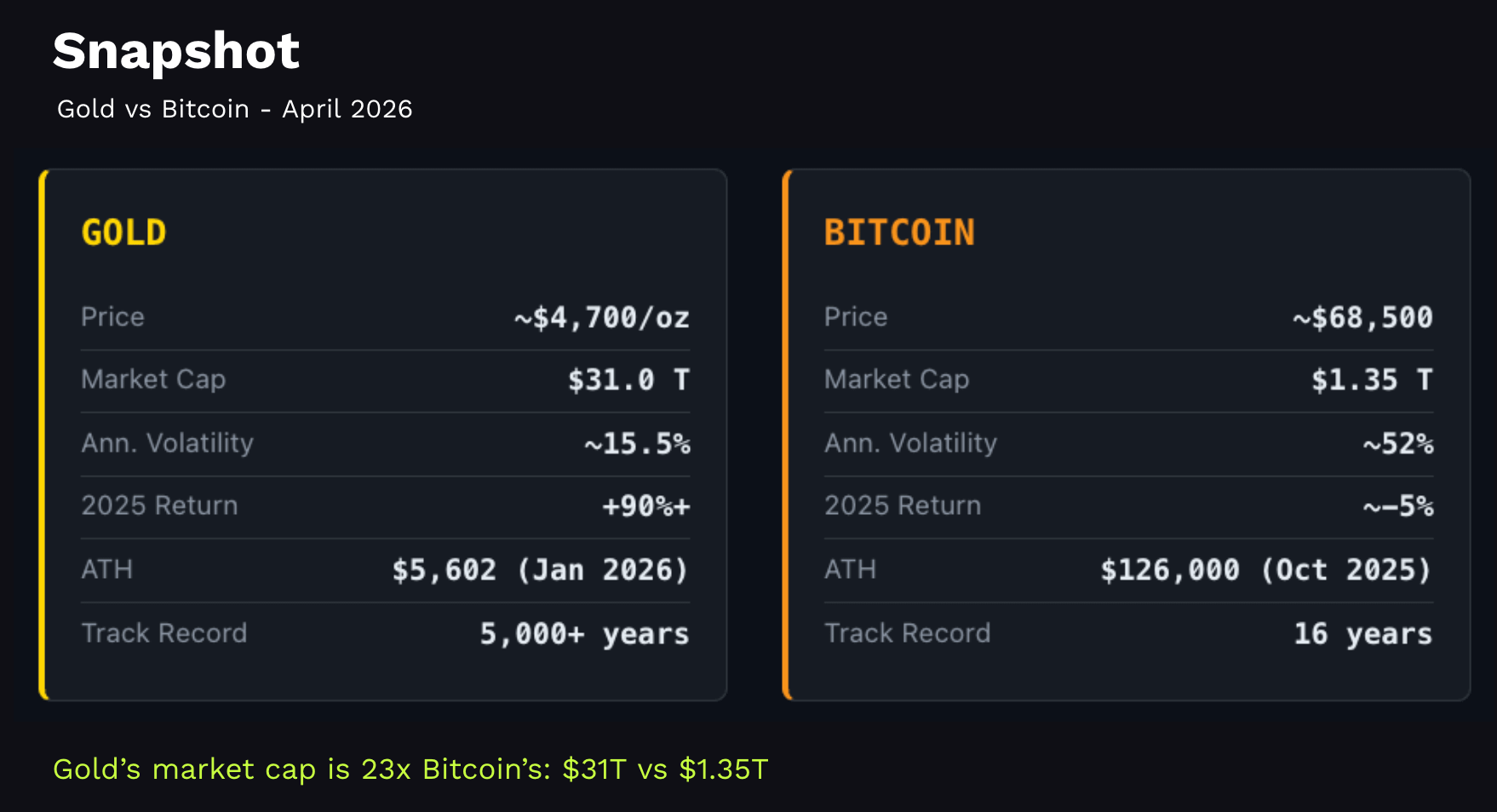
There are some strong parallels between gold and bitcoin.
1. First off, both are scarce assets. This is the core of the narrative.
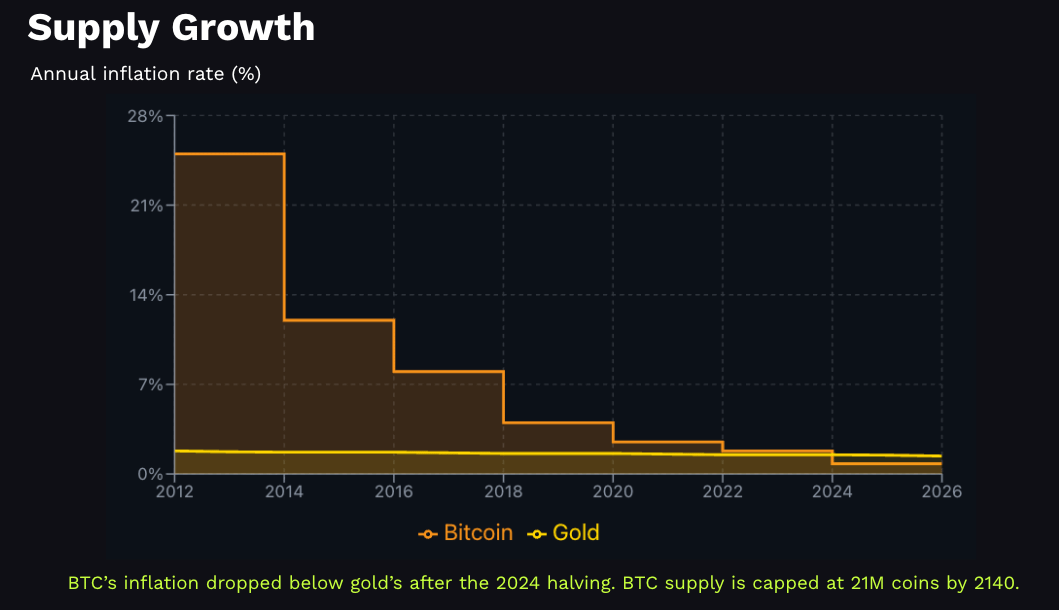
Gold’s above-ground supply is growing by about 0.5% a year. The rate of this supply growth also slows over time as deposits are mined/tapped out. On planet earth, gold is a scarce mineral.
Bitcoin is even scarcer than gold. It has a fixed supply of 21 million coins, with an annual inflation rate of 0.8%. Mathematically, bitcoin’s supply limit will be reached by 2140.
2. Neither produce cash flow. But yield doesn’t matter when money is free.
Bitcoin and gold derive financial value from scarcity and the collective belief these assets are a store of value within our monetary system. - This is the monetary premium.
And, in a system of perpetual debt expansion and currency debasement, there’s a collective belief in the monetary premium.
3. Both are macro assets.
Let’s look at a period where interest rate cuts and Fed liquidity were not the main driver. How did gold and BTC do between late 2022-24?
The Fed was aggressively hiking rates to fight post-COVID inflation, the Treasury was issuing massive amounts of debt, and some central banks were diversifying reserves, following the “dollar weaponization” by the U.S. against Russia in response to its invasion of Ukraine.
Historical performance supports the argument these assets a relevant to the global financial system, fiscal/monetary policy, and macro drivers.
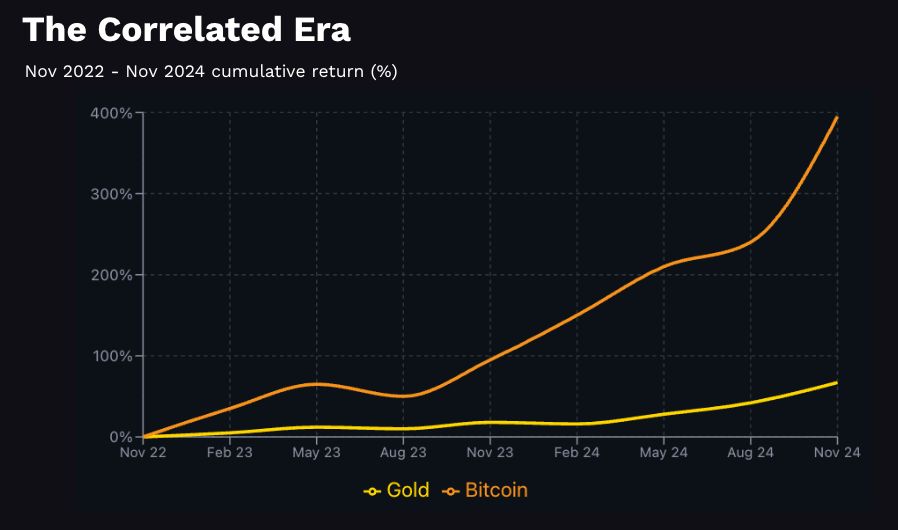
From November 2022 to November 2024 bitcoin and gold moved together, with gold gaining about 67 percent while Bitcoin surged almost 400 percent.
During this period, gold and bitcoin played a similar role for investors. Correlation or coincidence?
From the perspective of the role these assets play in the system, I believe they’re comparable. This wasn’t always true, but today total bitcoin ETF AUM is $100 billion and it’s become a legitimate holding among retail investors, institutions, corporates, and even sovereigns.
Where does the narrative breakdown?
For a while, bitcoin certainly looked a lot like a digital version of gold. Then 2025 happened, and the narrative cracked.
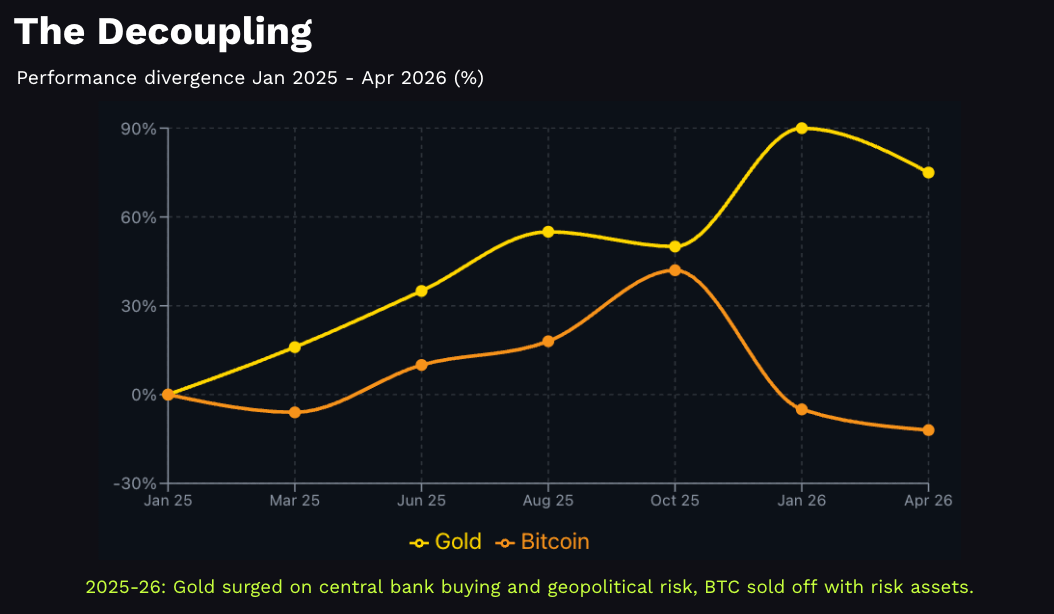
Gold went on an absolute tear in 2025, climbing from around $2,600 an oz, to an all-time high above $5,600 by the start of 2026. +115% in just over a year.
This was driven by numerous catalysts. Central banks were active in the market, geopolitical risk was increasing, and fears of inflation lingered. All factors often associated with higher gold prices.
Bitcoin also climbed higher during this time, hitting an all-time high of $126,000 in October 2025, before crashing hard due to idiosyncratic market events and a massive blow up of leveraged positions.
As of right now, it’s trading around $75k, down over 40 percent from its high and below where it started last year.
Bitcoin has failed to meaningfully recover since entering 2026, and its correlation with gold has weakened to basically zero. At the same time, its correlation with the Nasdaq has been consistently positive, running between 0.35 and and as high as 0.90.
BTC’s negative correlation with the dollar has also weakened to near zero. Today, it’s trading more like a high-beta tech stock, and not a macro hedge.
On the other hand, Gold has generally exhibited a weak negative correlation with stocks and performed as expected at the start of the Iran war.
Bitcoin as a macro hedge when markets get stressed, not so much. Instead, it’s been getting hit even harder during recent Nasdaq sell-offs.
The Volatility Elephant
Regardless of short-term shifts in correlations, a more common argument against bitcoin as digital gold is its volatility.
If an asset is a supposed safe haven or a store of value, presumably its price is relatively stable.
Stability is one of gold’s defining features, or at least it has been historically. Gold’s yearly realized volatility runs about 15 percent. It’s not zero, but it’s manageable.
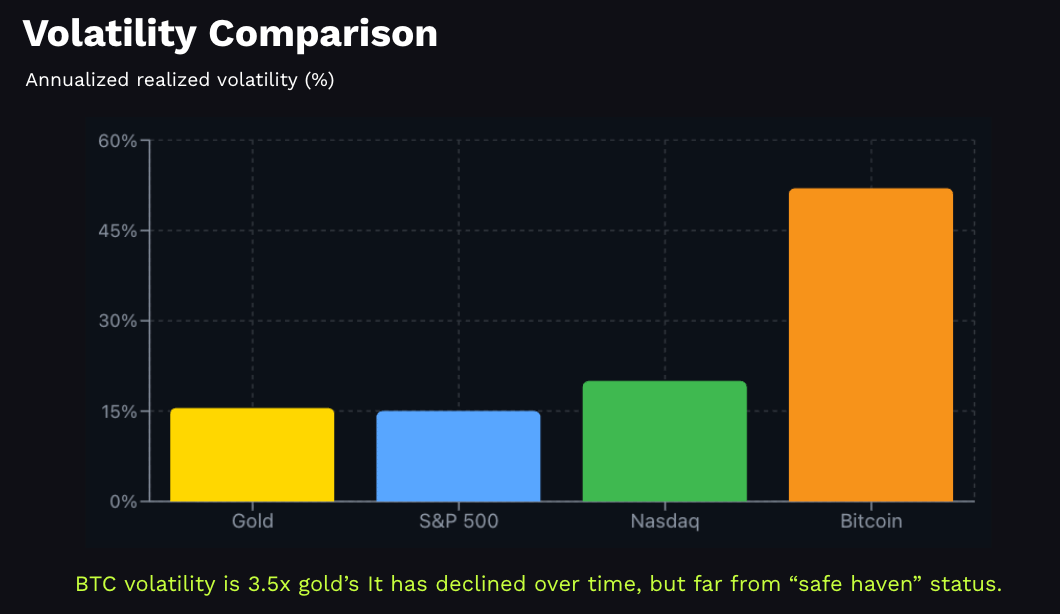
Conversely, bitcoin’s annualized volatility sits around 50 to 55 percent, even after declining significantly as the asset has matured.
Bitcoin’s vol is roughly 3.5 times gold’s volatility, but it has been declining on a secular basis.
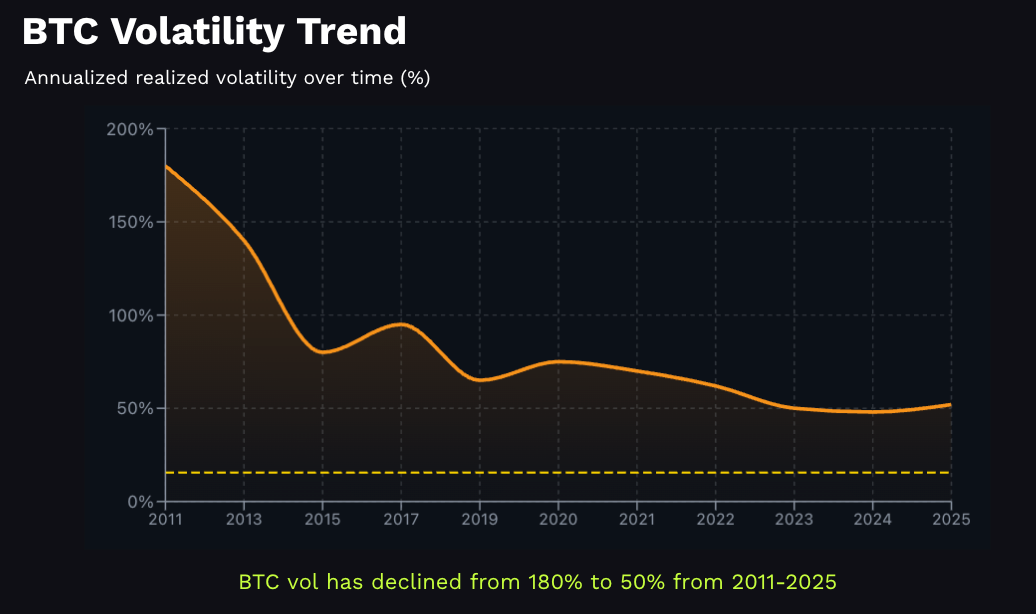
In its early years, it regularly hit triple-digit annualized vol, even trading above 200% at one point.
Since then, the ratio of Bitcoin vol to gold vol has compressed from over 10x down to around 3 and a half times as of early 2025.
Looking at volatility alone is not an entirely fair argument, as price discovery for new asset classes is inherently volatile.
Bitcoin is much less volatile today, but whether this volatility keeps declining toward gold-like levels as institutional adoption deepens has yet to be seen.
Bitcoin’s liquidity problem
Another important distinction and a contributing factor to bitcoin’s higher volatility, is the sheer size difference in market cap between bitcoin and gold.
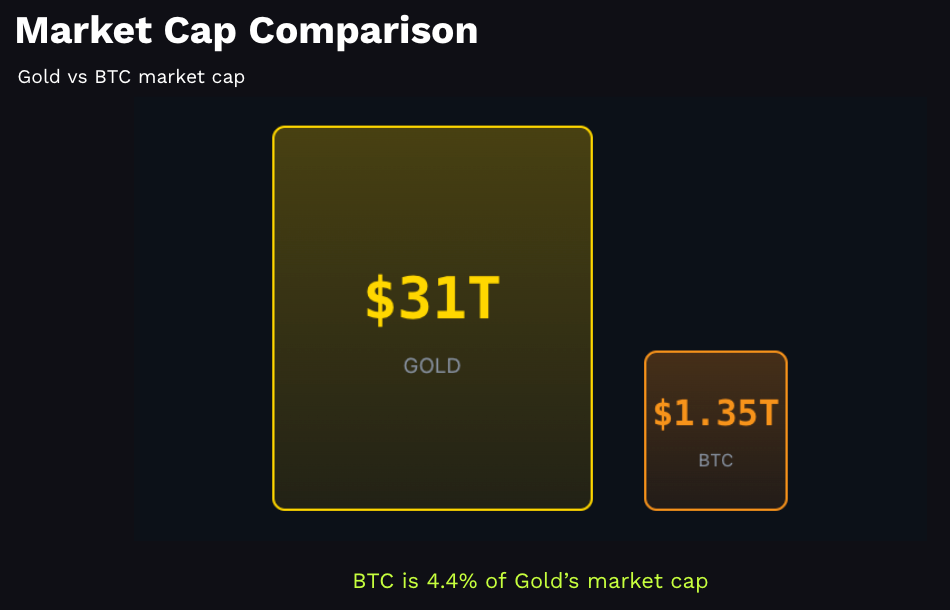
Gold has a market cap of around $31 trillion while bitcoin is closer to $1.3 trillion, meaning bitcoin’s market cap represents only four percent of gold’s total value at today’s prices.
This difference in market cap makes bitcoin a less liquid asset than gold, which results in its larger price swings.
For example, at current prices:
A hundred thousand Bitcoin is worth about $7 billion and represents roughly 13 percent of Bitcoin’s daily trading volume.
If this amount were sold in the market, it could cause an estimated 25 percent drop in price over a short period of time.
An equivalent volume in gold would be around 5 percent of its daily turnover and might move the price by closer to 2 percent.
From a trading perspective, institutions can move real size in gold without significantly impacting the market. This is simply not the case for bitcoin today.
Even at its peak, Bitcoin’s market cap pales in comparison to gold, but the speed at which bitcoin has reached this level is remarkable.
Bitcoin has only been around for 18 years, while gold has been used for thousands.
Behavior during a crisis
Finally, for bitcoin to really be digital gold, I’d argue, it needs to perform the role of a safe haven during times of crisis. For the most part, gold does.
I mentioned its performance at the onset of the war but let’s look at a few other notable recent periods.
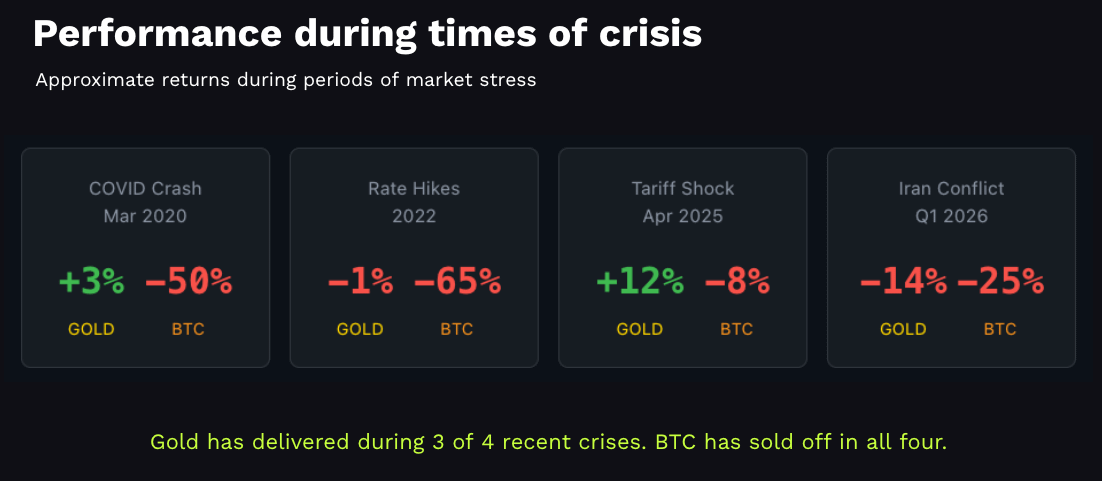
During the 2008 financial crisis, the COVID crash in 2020, and the tariff uncertainty of early 2025, gold either held steady or rallied while equities sold off.
Bitcoin’s track record is shorter and more mixed.
In March 2020, Bitcoin crashed alongside everything else, down about 50 percent in a matter of days.
During the tariff-driven selloff in early 2025, Bitcoin again fell with risk assets while gold surged.
In March 2026, there was actually a brief window where gold had its worst five-day drop since the 80, and Bitcoin showed some relative stability - But the broader pattern still favors gold as the more reliable crisis hedge.
The bottom line: gold has a track record as a defensive asset, while bitcoin has historically played a much different role.
Bitcoin behaves much more like a tech stock or a commodity investment.
Bitcoin vs gold, how about both?
The digital gold analogy is a simple way to view bitcoin as an investable asset, but objectively there’s little evidence it performs the same role in a portfolio as gold.
This doesn’t mean we should write it off, as bitcoin’s upside volatility has historically benefited investors, assuming a reasonable allocation.
In my opinion, you want both in your portfolio. Gold as a geo-political hedge and long-term safe haven, and Bitcoin for its presumably asymmetric return profile given its early stage adoption, and its perceived monetary premium.
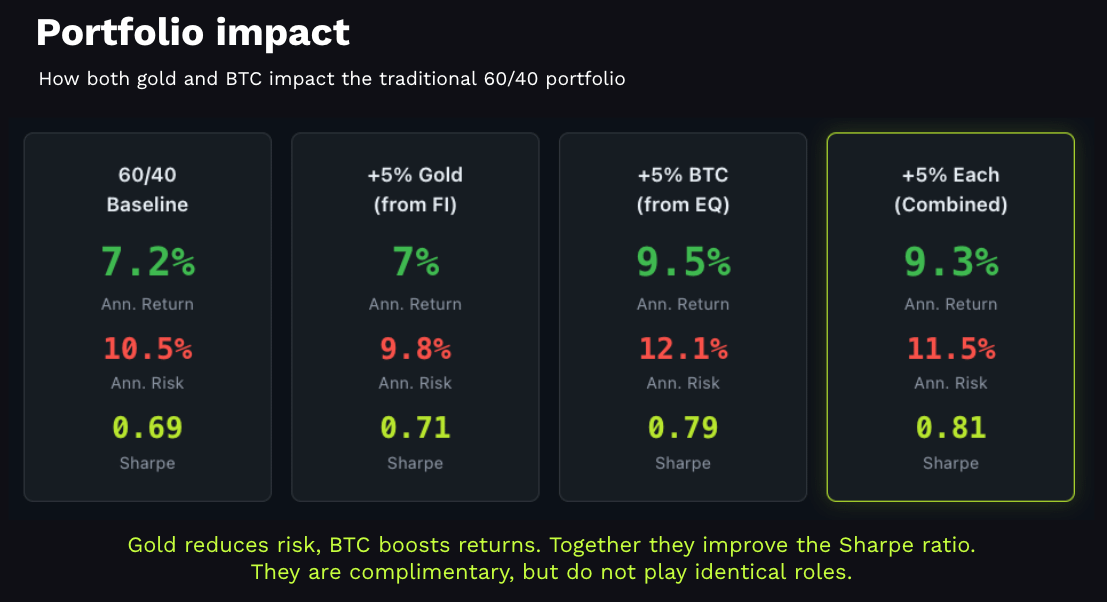
A reasonable framework might be to put 5 to 10 percent in gold, and 1 to 5 percent in Bitcoin, but that of course depends entirely on your own situation, risk tolerance and time horizon.
Final Verdict
Is Bitcoin digital gold?
The honest answer: not yet, and maybe not ever in the way most people mean it.
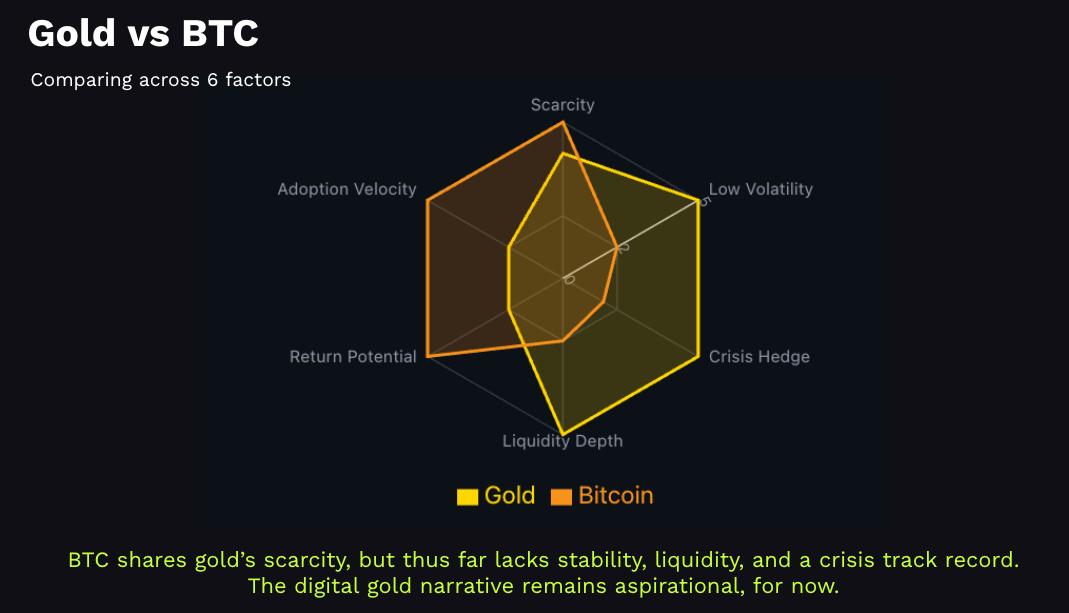
Bitcoin does share some of gold’s most important properties. It’s scarce, resistant to dilution and manipulation, and it’s not controlled by a single government.
These are important features.
But Bitcoin lacks gold’s stability, its deep liquidity, its five-thousand-year track record, and critically — its proven ability to protect portfolios during market meltdowns.
The digital gold narrative is useful as a starting point for understanding Bitcoin. But the data shows Bitcoin trades more like a high-beta tech stock that happens to have some store-of-value characteristics.
Again, I think you want to own both.
That’s it for this week. Thanks for reading and supporting us at tastycrypto. If you enjoyed the content, please like and share it, and help us grow our audience.
Keep your head on a swivel.
And, as always…
Stay tasty,
Ryan
Trading platform and brokerage: tastytrade
Crypto trade ideas and more content: YouTube
Follow: X
Disclaimer: None of this is to be deemed legal or financial advice of any kind and are solely the opinions of the authors. tastycrypto is provided by tasty Software Solutions, LLC. tasty Software Solutions, LLC is a separate but affiliate company of tastylive, Inc. and tastytrade, Inc. Neither tastylive, Inc. nor tastytrade, Inc. are responsible for the products or services provided by tasty Software Solutions, LLC. Cryptocurrency trading is not suitable for all investors.